

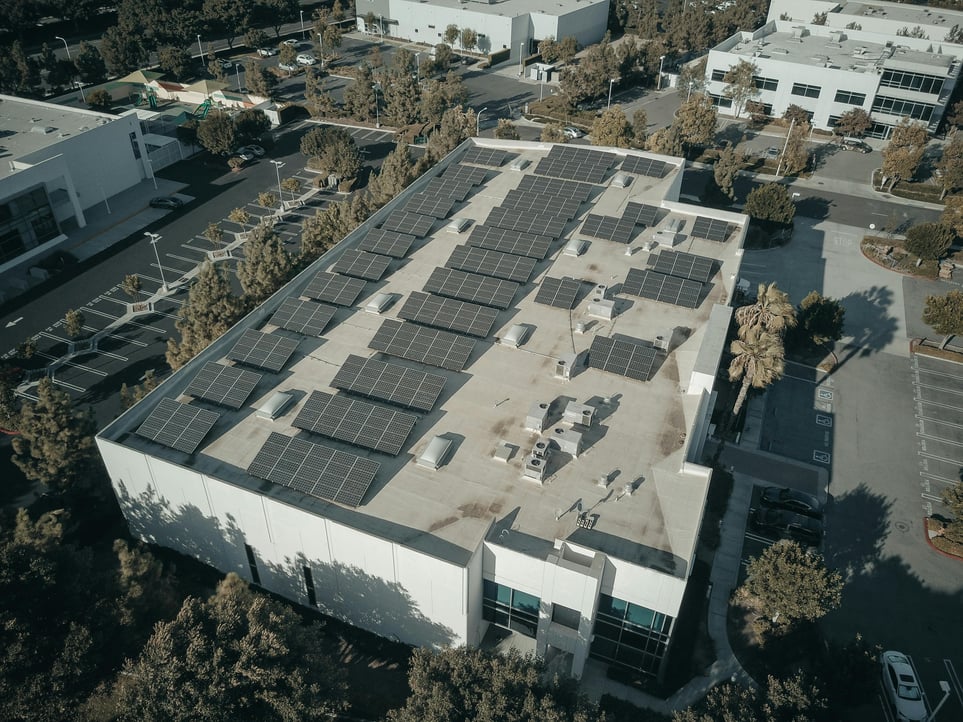
 As solar installations become more widespread across complex environments, understanding how fire risk develops in less visible areas is becoming increasingly important. This article explores what the Bristol hospital incident reveals about rooftop vulnerabilities, the challenges of early intervention, and how detection strategies can evolve to support safer adoption of solar technology.
What the May 2025 Bristol Hospital Fire Tells Us About Rooftop Solar Fire Risk
The rooftop fire at St Michael’s Hospital in Bristol in May 2025 was a sharp reminder that fire risk must be considered alongside the growth of solar installations.
The fire broke out on 22 May 2025 at the maternity hospital, prompting the evacuation of patients and staff. Thankfully, no injuries were reported, and services resumed shortly afterwards. Avon Fire & Rescue later said the fire was accidental and caused by a fault in the solar panels on the roof.
While the incident was brought under control without loss of life, the circumstances made it especially striking. A hospital is already a complex environment to evacuate, and in this case it involved mothers, babies and expectant families in a highly sensitive setting. It underlined how disruptive even a localised rooftop fire can become when it affects critical infrastructure.
Why rooftop solar fire risk matters
Solar panels are an increasingly common part of modern buildings, from hospitals and warehouses to schools, offices and transport sites. They offer clear environmental and operational benefits, but like any electrical installation, they also introduce fire risks that need to be understood and managed.
Where faults occur, overheating can develop in a highly exposed area of the building. Depending on the cause, that may involve damaged components, electrical faults, ageing equipment or installation-related issues. Because rooftop systems are often out of sight, a developing problem may not be noticed until it has already escalated.
The challenge of early intervention
One of the key issues with rooftop fire incidents is access. Even when the fire itself is relatively contained, detecting it early and responding quickly can be more difficult than in other parts of a building.
That is why early warning is so important. In many cases, overheating is likely to be one of the first indicators that something is wrong. Detecting abnormal heat rise before visible flames develop can provide valuable time to investigate, isolate the issue and respond before the incident becomes more serious.
This is particularly important on rooftops, where traditional point detection may not always be the most effective approach and where environmental conditions can make fire development harder to spot quickly.
Where linear heat detection can help
In applications such as rooftop solar arrays, linear heat detection can offer a practical way to monitor for developing overheating along the installation itself.
FFE’s Proreact linear heat detection is designed to detect temperature rise continuously along the cable route, helping identify abnormal heat build-up across the protected area. In the context of solar installations, this can support earlier intervention where a hotspot or fault begins to develop.
The right fire strategy will always depend on the layout, building type and overall risk profile, but the principle is clear: as rooftop solar becomes more common, fire detection needs to keep pace.
A wider lesson for modern buildings
The Bristol incident was not simply a rooftop fire. It was a reminder that even a fault in one part of a building can have much wider consequences when the site supports critical services.
Whether the setting is healthcare, education, transport or commercial property, the same question applies: are fire detection and protection measures keeping up with the way buildings are changing?
As more organisations invest in solar technology, it is important that safety is designed in from the start, not treated as an afterthought.
Final thoughts
The May 2025 fire at St Michael’s Hospital showed how quickly a rooftop incident can disrupt a live environment. Fortunately, no one was harmed, but it highlighted the importance of recognising overheating in solar installations as a genuine fire risk.
Solar panels remain an important part of modern infrastructure, but safety must evolve alongside adoption. Early detection, appropriate system design and a clear understanding of where fire risk may develop all have an important role to play in protecting people, property and continuity of service.