

Fireray safeguards one of England’s oldest cathedrals with precision beam detection
FFE’s state-of-the-art reflective beam smoke detector helped specialists design a powerful but discreet fire detection system that could be cost-effectively installed and maintained.
Key Facts
- Optical beam smoke detection was selected as the most viable option for protecting the high-level spaces throughout the ancient cathedral in Ripon, North Yorkshire.
- The Fireray One offered the required performance coupled with a fully automated beam alignment routine, and advanced algorithms to compensate for dust contamination of the optics and varying light levels close to windows.
- Detectors in specific areas were supplied with coloured covers to blend in with the architecture and make the system as discreet as possible.
- Coloured covers were developed though a variation agreement with all key parties prior to an order being placed.

Balancing ancient and modern
The site of the cathedral in Ripon, North Yorkshire, UK, has been a place of worship for at least 1350 years. The present church, the fourth on the site, was built between the 13th and 16th centuries. It is a masterpiece of the Early English Gothic style and is a Grade I listed building. Over 100,000 visitors come each year to marvel at its splendour and find a moment for quiet contemplation within its walls.
Protecting such a treasure is a heavy responsibility. Losses from fires in such places as these can be irreplaceable, but any measures must be sympathetic to the architecture and not mar the beauty that makes the building so significant. This consideration was uppermost in the minds of those managing a recent upgrade of the cathedral’s fire detection and alarm system.
The upgrade was motivated by issues with the existing air-aspirating smoke detection system, which was aging and had experienced a number of faults and false activations. The site managers were therefore keen to move away from this technology and look at alternatives. Although point smoke detection was used in some areas, this would have been expensive to install and maintain in the high-level spaces of the building, where detection was needed at heights of up to 24 metres above floor level. In these areas, the option of optical beam smoke detectors was particularly attractive.
The designers of the detection system, Charles Thomas Heritage Fire Protection Specialists Ltd, selected the Fireray One reflective beam smoke detector from FFE as their preferred choice. With a range of up to 120 metres, this detector is more than capable of protecting the distances involved, and is also equipped with several other features that were important in this particular application.
From tower to transept
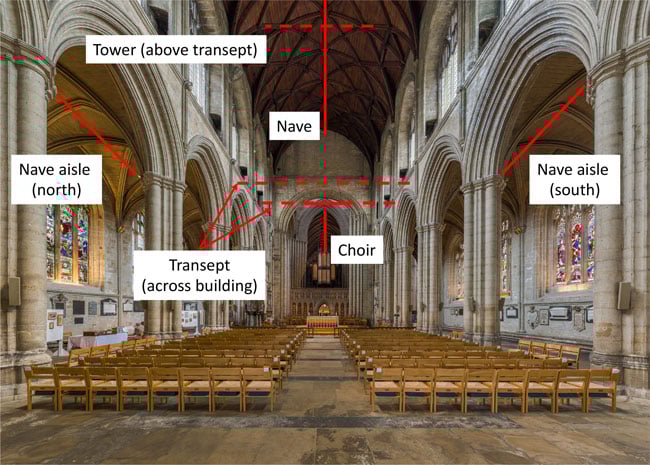
Seven Fireray One beams were installed in the main cathedral space: two along the north and south aisles of the nave (where the congregation sits); one each under the wooden vaulted ceilings in the nave and the choir; two passing across the width of the building on each side of the transept; and finally, one across the tower above the transept.
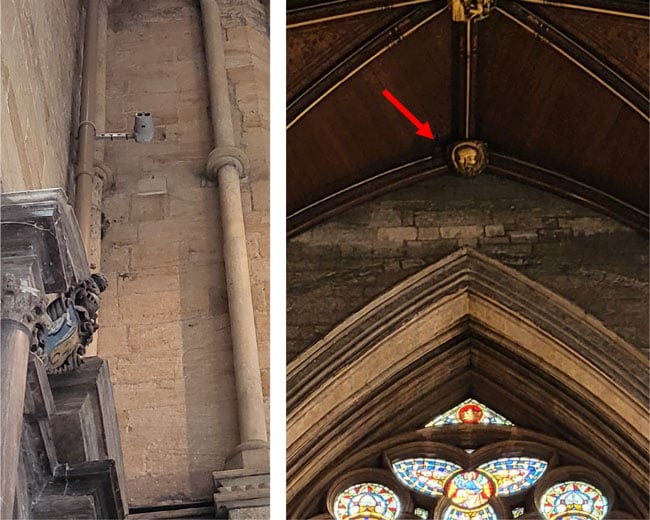
A variety of methods were used to mount the detectors. Those in the transept were wall-mounted on adjustable brackets close to a high-level walkway. In the nave aisles, a strut was used to fix the detector to an internal drainpipe. Most ingeniously, the detectors under the ceilings in the nave and choir were installed by creating a small access hatch in the wooden panelling, through which the detector could be suspended, fixed to a strut.
In addition to the seven beams in the public areas, a further four Fireray One beams were installed in roof spaces above the choir and transept. Once again, access to these areas wasn’t entirely straightforward so there was significant benefit in minimising the number of detectors required.
Hiding in plain sight
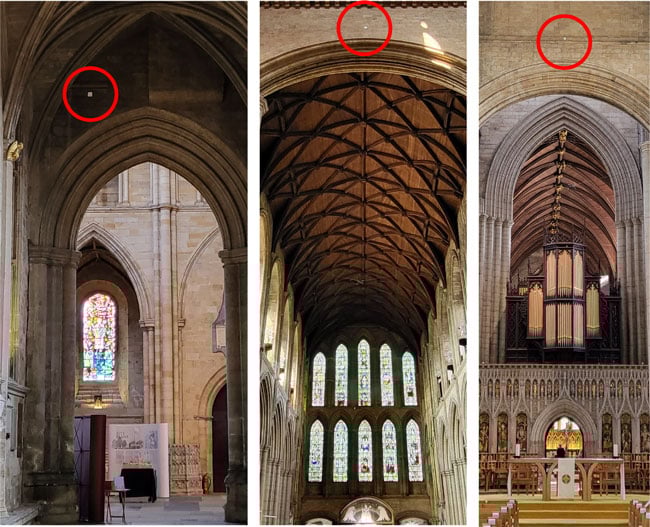
Due to the cathedral’s construction, it was not possible to hide the detectors in the public areas in cabinets or behind partitions. As they would be in full view of visitors, it was important that they blended in with the architecture as much as possible. Although the standard white covers of the Fireray One are well-suited to contemporary buildings, they would have been incongruous in this case. Accordingly, for this project, several of the beam detectors were colour-matched to their surroundings. The two detectors in the nave aisles were coloured stone grey (RAL 7030), while those underneath the wooden ceilings were coloured grey-brown (RAL 8019) and are so well camouflaged that they are virtually invisible when viewed from below.
In all cases, the detector units needed a corresponding reflector to be mounted on a suitable surface at the other end of the protected space. The integrated laser contained in the detector made identifying the location for mounting this reflector straightforward. Then, once both components were installed, aligning the beam with the reflector was easy due to the Fireray One’s fully automated alignment routine. This involves a four-step process of measuring the background signal, locating the reflector, maximising the signal of the reflected beam, and finally finding the edges of the reflector and centering the beam so that it shines squarely on the reflective surface. As well as drastically reducing the time required to install the detectors, this ability to adjust the direction of the beam automatically allows the Fireray One to compensate for any gradual loss of alignment that occurs over time, for example if parts of the building expand or contract due to seasonal changes in temperature.

Seeing the light
Some of the beams, especially those in the transept, were installed close to large windows. Depending on the season and the time of day, the light levels would be expected to vary considerably at these locations. In some beam detectors, this can cause saturation (effectively ‘blinding’ the detector) or generate false alarms. However, the Fireray One benefits from patented Light Cancellation Technology™ which isolates the infrared beam from any ambient visible light being received by the detector. This allows the critical infrared signal to be measured accurately, ensuring that detection efficiency is not compromised.
Ongoing maintenance of any fire protection system must always be a major consideration, especially in buildings where access to certain areas may be limited. In this case, the Fireray One mitigates some of the required effort due to its contamination compensation algorithm, which can correct for a gradual build-up of dust on its lenses over time. Although cleaning will usually be needed eventually, this is likely to be a less frequent necessity in all but the dustiest environments.
Regulations also require that systems are tested annually to check they are still performing at optimum efficiency. In the Fireray One, this means blocking the beam at the reflector – at first gradually to simulate a fire, and then suddenly to check that a fault signal is generated if the beam is obstructed. The choice of location of the reflectors was therefore as important as that of the detectors, as they needed to be as discreet as possible while remaining suitably accessible for testing purposes. For example, the beams in the nave and choir were angled slightly downwards so that the reflectors could be mounted in a more convenient spot just above an archway, rather than directly underneath the wooden ceiling.
Ripon Cathedral now enjoys a significantly higher level of protection from fire than previously, thanks in part to the state-of-the-art features of the Fireray One.

Fireray One Motorised Beam Detector
Managing Director at Charles Thomas, commented, “FFE have always provided exceptional technical support, whether at tender stage, installation or during service and maintenance of their products. As the client has experienced a number of false activations and faults on the existing system over a period of years, they were quite adamant that an alternative be sourced, and the Fireray One was best suited for this project.”
