

Meeting the challenges of reliable smoke detection in a new art gallery
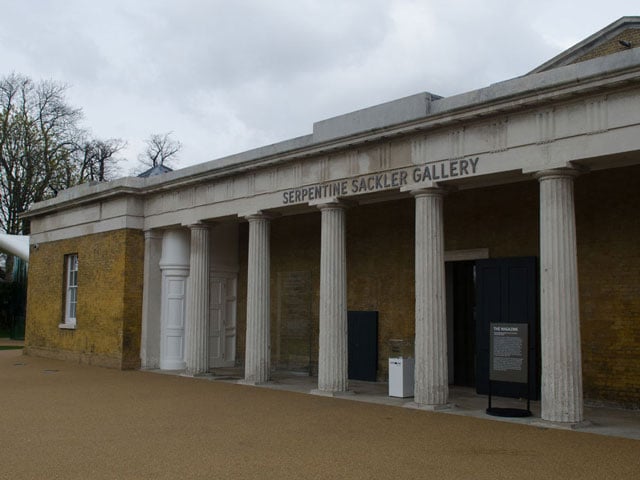
The Serpentine Gallery has been exhibiting collections of contemporary art, architecture and design at the heart of Kensington Gardens in London since 1970. In 2013, a 200-year-old disused gunpowder store on the opposite side of the Serpentine River was extended and converted into the Serpentine Sackler Gallery, to increase the space available for exhibitions and provide a restaurant and shop for visitors.
The conversion of such a building for a purpose far removed from its original use presented the architects with a number of interesting challenges and opportunities. Firstly, it was important that the beauty and character of the historic original building should be preserved, while of course ensuring that the refurbishment met modern standards for safety and quality. Secondly, the building’s new purpose of displaying valuable pieces of art presented some exacting requirements connected with the lighting of the interior. These twin concerns in particular led the specifying engineers Arup to select FFE as the providers of smoke detection systems for the new gallery.
The challenge
The main gallery space is surrounded by four skylights, each fitted with external louvres to allow diffuse natural lighting of the building. These skylights, which vary in length from 17 to 21 metres, sit above a series of steel joists that support the roof of the building. This forms a series of narrow voids around the gallery, along which smoke detection is needed as part of the fire protection system for the entire building.
One of the primary concerns for any art gallery is the level of light inside the exhibition space, which must be controlled to preserve the artworks from damaging effects such as fading. For this reason, the new gallery has retractable blinds positioned under the skylights; these allow blackout conditions to be created inside the building when required. These blinds not only restrict the space above the joists still further, but they also have a reflective white surface on one side which, for aesthetic reasons, the architect specified should face the interior of the building. Therefore, when the blinds are closed, this reflective surface is immediately above the void in the roof.
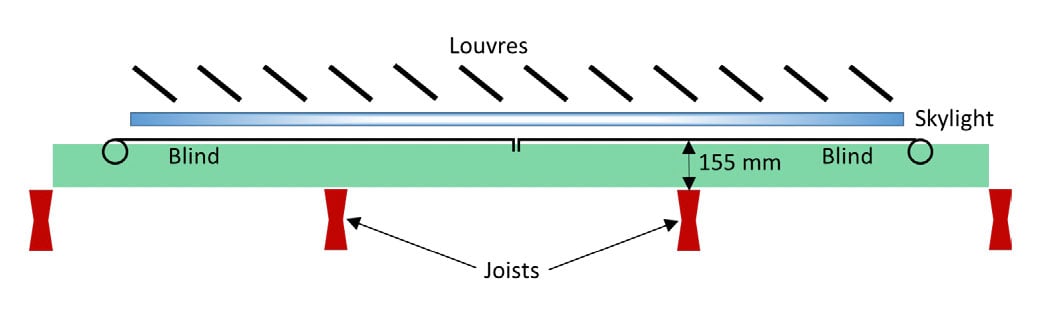
Diagram of the area to be protected (shaded green) with blinds closed
The architects wanted the smoke detection system to be as unobtrusive as possible. This ruled out point detection, which would have entailed installing numerous detectors at regular intervals along the length of the skylight to ensure reliable performance. Aspirating systems were also unsuitable, as the network of pipes needed to carry the sampled air to the detector would be visible to users of the gallery. An optical beam detection system was the preferred option, as the components could be hidden at each end of the void without causing any loss of performance.
As a manufacturer and supplier of a range of optical beam smoke detection systems with over 40 years of experience in the fire protection industry, FFE was selected to recommend and provide a system for the new gallery.
The FFE solution – Fireray 3000
FFE recognised that the presence of reflective surfaces very near to the space requiring protection demanded the projection of a narrow, precisely focussed beam along the length of the skylight between the blinds and the tops of the joists. The recommended solution was the Fireray 3000 infra-red optical beam smoke detection system, which has an end-to-end configuration. These systems, where a transmitter and a receiver are installed at the extremities of the area being protected, are suited to highly restricted spaces with reflective surfaces close to the path of the beam.
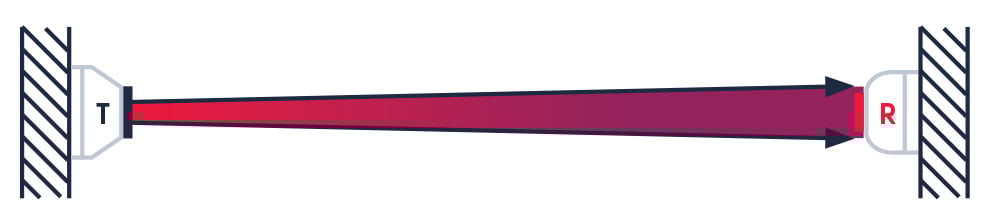
Diagram of beam path in an end-to-end optical beam smoke detector
Feature thumbwheels and are designed to be set up and aligned easily by a single engineer. An in-built laser is used for visual targeting of the receiver towards the transmitter. Accurate alignment of the beam then follows, with flashing green or amber LEDs on the receiver indicating whether the signal is too high or too low. Thanks to this precise alignment capability, the Fireray 3000 can protect an unusually wide range of distances, from 5 to 120 metres. Furthermore, the beam can pass through gaps as small as the diameter of the receiver lens if the system is installed and aligned correctly.
In view of the technical challenges posed by this application, FFE engineers attended the site at an early stage of the system’s installation. They ensured that the transmitter and receiver were mounted firmly at the ends of each skylight, using blocks attached to the structural framework of the building. They also performed tests on site to confirm that the performance of the Fireray 3000 would not be affected by the blinds being opened or closed as part of the gallery’s normal operation.
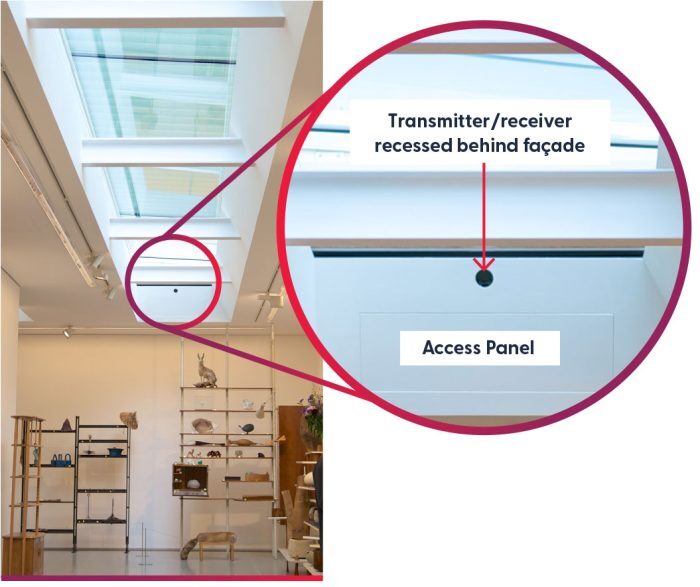
The final installation and receiver of the Fireray 3000 would be hidden behind a façade for aesthetic reasons. Accordingly, ports 70 mm in diameter were provided through which the beam could pass. In addition, removable panels were available to permit access to the system in case realignment should be needed in future.
The combined result of FFE’s expert technical support and the capabilities of the Fireray 3000 was that the architect’s requirements for an unobtrusive and reliable smoke detection system housed in a very confined space were fully met. The detectors, completely unnoticed by visitors, worked perfectly when the new Serpentine Sackler Gallery opened its doors in April 2013, and they are successfully protecting the works of art exhibited there to this day.

Fireray 3000 End-to-End Beam Smoke Detector
