

Fireray protects Guardians of Justice in the City of Angels
FFE’s Fireray 5000 smoke detection system offered the architects of the new federal courthouse in Los Angeles a reliable and discreet solution for protecting the public areas in this innovative building. The detectors are mounted in relatively inaccessible areas for optimum effectiveness without the need for frequent and costly maintenance.
Key Facts
- The Fireray 5000 system is installed at the top of the high central atrium of the building which links all ten floors.
- Control panels permit the detectors to be aligned remotely, and allow a remote fire test of the system to be performed; these features prevent the limited accessibility of the detectors from being a costly problem.
- The system can compensate for movement in the building and dust accumulation on the lenses, reducing the frequency of maintenance and realignment.
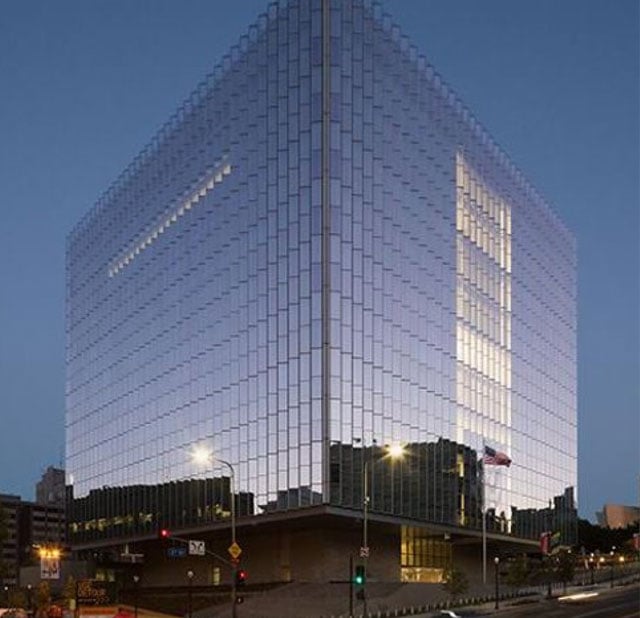
A state-of-the-art smoke detector for a state-of-the-art building
Completed in 2016 at a cost of $326 million, the new federal courthouse in downtown Los Angeles in California is a truly innovative building. Among its many features is a serrated façade which maintains high natural light levels while reducing the amount of heat absorbed by the building and thus lowering the energy consumption from air conditioning. This façade also gives the building a very distinctive appearance.
The design of the internal space is highly contemporary, with a central atrium linking all ten floors. This atrium, a key component in the building’s structure, is therefore an area that requires careful monitoring as part of the fire protection system, which was installed and commissioned by SimplexGrinnell. They selected FFE’s Fireray 5000 optical beam smoke detectors as the means of identifying if a fire has occurred in this large, bright and well-ventilated area.

The central atrium of the courthouse (Clark Construction Group LLC)
The beam advantage
The large size of the atrium makes it unsuitable for conventional point smoke detectors, as a great many units would be needed to cover the area comprehensively which would require a complex and costly control network. It is in these types of applications that the advantages of reflective beam detectors come to the fore.
Smoke particles are very effective at scattering light, and so the brightness or intensity of a light beam through which smoke passes will reduce at a point beyond the smoke-filled area. Optical beam smoke detectors take advantage of this phenomenon to detect the presence of very low levels of smoke across large distances. Reflective systems feature a beam transmitter and receiver housed in the same unit, and the beam is reflected from one to the other using a reflector mirror at the far side of the protected area.
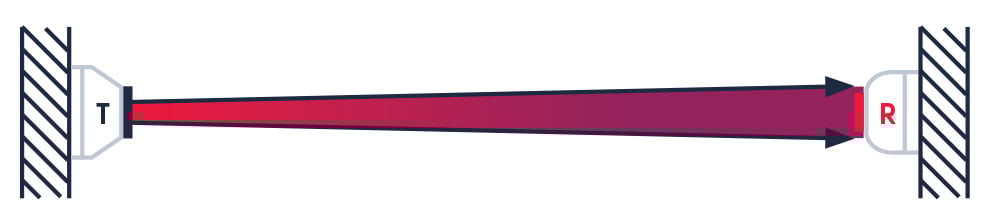
Diagram of beam path in a reflective optical beam smoke detector
Remote access – a critical requirement
FFE’s Fireray reflective optical beam smoke detectors are able to detect smoke over a distance of between 8 and 100 metres, which is more than sufficient to protect the atrium in the federal courthouse. However, to effectively detect if a fire has occurred, the detectors must be positioned high up in the atrium as the hot gases in the smoke will force the particles upwards. They also need to be discreet to avoid spoiling the aesthetics of the building’s clean and modern design. “As the units are situated high up, physically accessing them regularly is exorbitantly expensive and impractical, so remote access is essential,” says SimplexGrinnell’s Construction Manager, Sharon Brown. They selected the Fireray 5000 because it has several features designed specifically for such applications.
The installation of the system was very straightforward. All that was required was to mount the detector and the reflector directly opposite each other across the area to be protected. Each detector was then connected to a controller which can be positioned up to 100 metres away. Using this controller (which can control up to two detector units), an integral laser on the detector was activated which allowed the detector to be approximately aligned with the reflector using buttons on the controller. The system software then performed an auto-alignment routine which took less than 5 minutes to precisely align the detector optics and gave optimum performance of the system.
Now that the system is operational, a remote fire test can be initiated from the controller, which checks the wiring to the building’s fire control panel as required by local fire authorities without requiring direct access to the detectors.
However, the maintenance of the system doesn’t stop at this point, especially in a relatively new building. A degree of settling of the building will occur over time, and this small movement could affect the alignment of the detector and the reflector. The auto-alignment routine can therefore be re-run as needed to maintain the system’s performance. There may also be gradual dust accumulation on the detector’s lenses, but the system features a Contamination Compensation routine that automatically compensates for this gradual drop in the measured signal, and this reduces the required frequency of physical cleaning of the detector itself.
Thanks to the low-level controller and the sophisticated detector module, the Fireray 5000 reflective beam smoke detector exactly fits the requirements for this high-profile building, and quietly and discreetly protects the people performing their important work in this famous city.
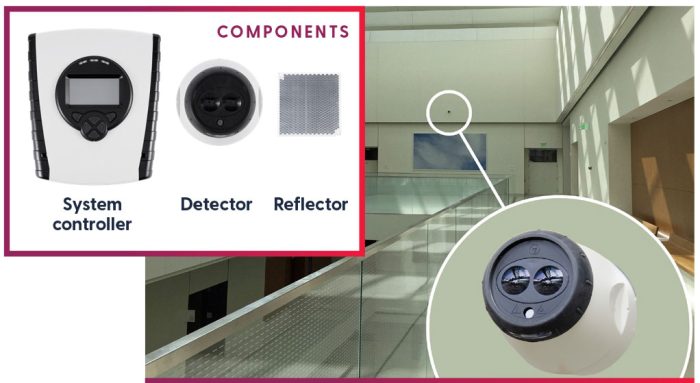
FFE’s Fireray 5000 system protecting the courthouse atrium